Cataract Surgery
Cataract Surgery in San Diego
Restore clear, vibrant vision with fellowship-trained cataract & refractive surgeon Medi Eslani, MD, FAAO, serving Chula Vista, National City, Escondido, and El Centro.
Understanding Cataracts
Clear, comfortable cataract surgery
One of the most common and successful procedures in medicine, performed by a surgeon who takes the time to get it right for you.
What is a cataract?
A cataract is a natural clouding of the eye's lens that develops gradually with age. Vision becomes blurry, dim, or yellowed, often with glare and halos. During surgery, the clouded lens is gently removed and replaced with a clear artificial lens (an IOL), restoring clarity for the vast majority of patients.
Signs it may be time
Causes & Risk Factors
Why cataracts form
A cataract is not a growth, and it is not a film over the surface of the eye. The lens inside your eye is built from water and protein arranged in a precise structure that keeps it perfectly clear. Over decades that structure gradually breaks down, the proteins clump together, and the lens stiffens and yellows. It is a normal part of aging rather than anything you did wrong, and most people develop some degree of cataract by their seventies.
What can speed it up
Age, by far the largest factor
Diabetes, particularly with variable blood sugar
Years of UV exposure without sunglasses
Smoking
Long-term steroid use, including inhaled and drop forms
Previous eye injury, inflammation, or eye surgery
Family history
Signs it is affecting your life
Night driving has become stressful, or you avoid it
Oncoming headlights and sunlight cause disabling glare
Reading is harder even with an up-to-date prescription
Colors look faded, dull, or washed with yellow
Your glasses prescription keeps changing
You have quietly given up activities you used to enjoy
You do not need to wait until a cataract is “ripe.” That advice comes from an era of older surgical techniques, and delaying does not improve the outcome. The right time is when your vision begins to limit the life you want to live.
Advanced Technology Lenses
Choose how you want to see
Your lens choice shapes your vision for life. Dr. Eslani will match the right lens to your eyes and lifestyle.
Your eye works like a camera. A camera can focus on things far away, things across the room, things at arm's length, and things up close. Your eye needs to do all four. We use our eyes at these four distances every day.
- Zone 1: Far away. Street signs. A golf ball.
- Zone 2: Across the room. The television. Pictures on the wall.
- Zone 3: Arm's length. The car dashboard. The stove. A computer screen.
- Zone 4: Up close. A book. Your phone. The tiny print on a pill bottle.
When you were young, the lens inside your eye changed shape on its own to focus near and far. It worked like a camera that autofocuses by itself. As we get older we lose that ability. That is why most people past fifty need reading glasses, bifocals, or progressive lenses just to get through the day.
Basic Monofocal
This is a dependable lens option and is typically covered by insurance. However, after surgery, you should expect to need glasses for all four zones of vision: distance, intermediate, near, and fine detailed tasks.
Toric
It corrects astigmatism to provide sharper distance vision. This option is mainly designed to improve one zone of vision, usually distance, making you less dependent on glasses for far-away tasks like driving or watching TV.
Extended Depth of Focus
It provides a smooth range of vision from distance to intermediate, which is excellent for driving and using screens. It gives you three useful zones of vision, less dependent on glasses. However, you may still need reading glasses for very small print or in dim lighting.
Multifocal & Trifocal
It provides vision at distance, intermediate, and near, giving you the most freedom from glasses. It is designed to help you function across all four zones of vision, including far distance, computer range, reading range, and closer near tasks, making you much less dependent on glasses.
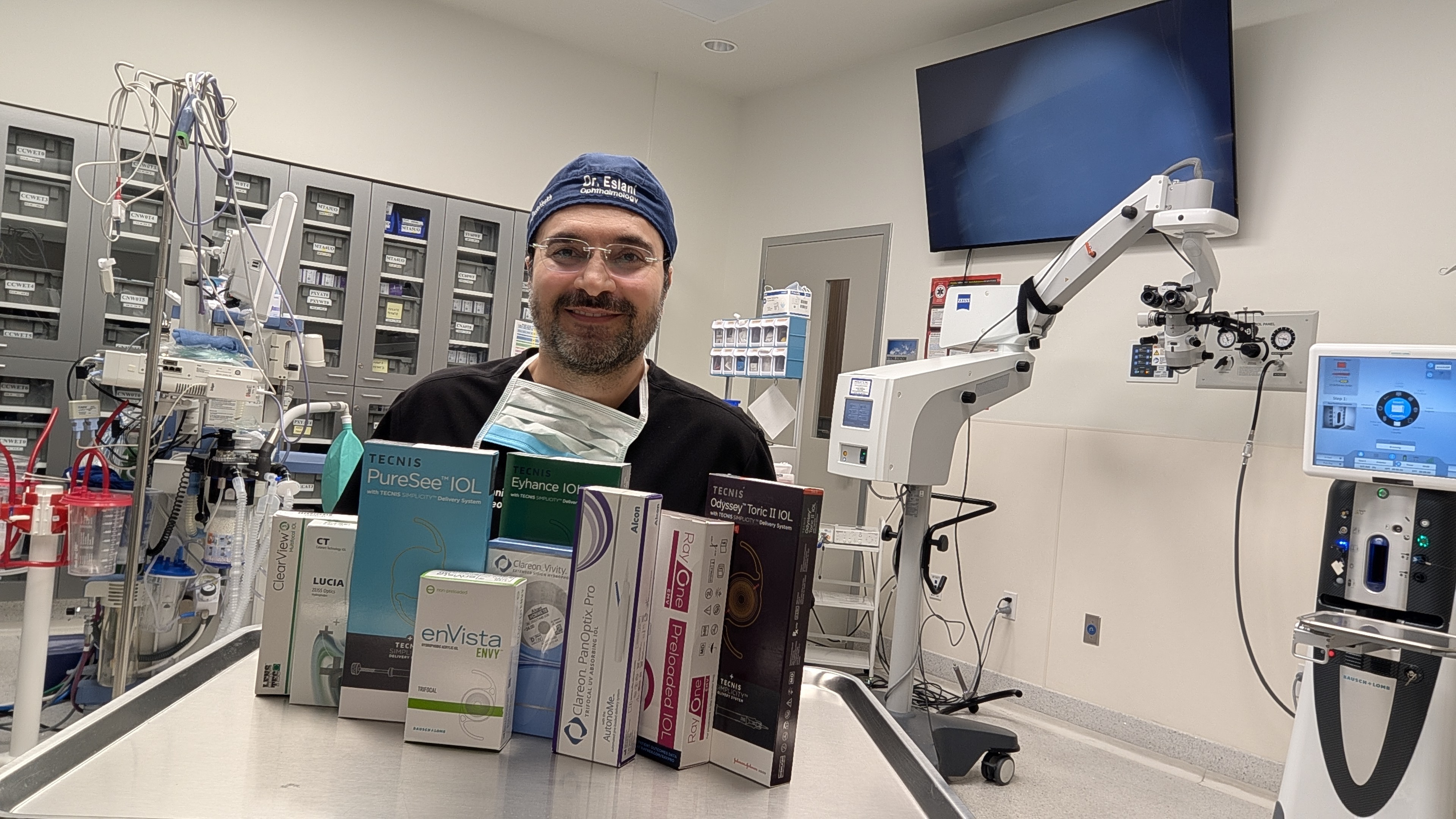
Dr. Eslani works with the full current generation of advanced technology lenses from every major manufacturer, so the lens is matched to your eyes rather than to what is on the shelf.
Lens Technology
The lenses Dr. Eslani implants
No single lens is best for everyone. Dr. Eslani works with the full current generation of intraocular lenses from every major manufacturer, which means the lens is chosen to fit your eyes and how you actually use them, rather than fitting you to whichever lens the practice happens to stock.
Newest generation · FDA approved 2026
TECNIS PureSee: extended range without the contrast trade-off
Presbyopia-correcting lenses have historically involved a compromise: extending your range of vision often came at the cost of contrast, particularly in dim light. TECNIS PureSee is the first extended depth of focus lens approved in the United States whose FDA labeling carries no warning about loss of contrast sensitivity. Its labeling states that it maintains distance visual acuity and contrast sensitivity at the level of a monofocal lens, while significantly improving intermediate vision.
Dr. Eslani's practice is one of a small number of practices in Southern California offering this lens.
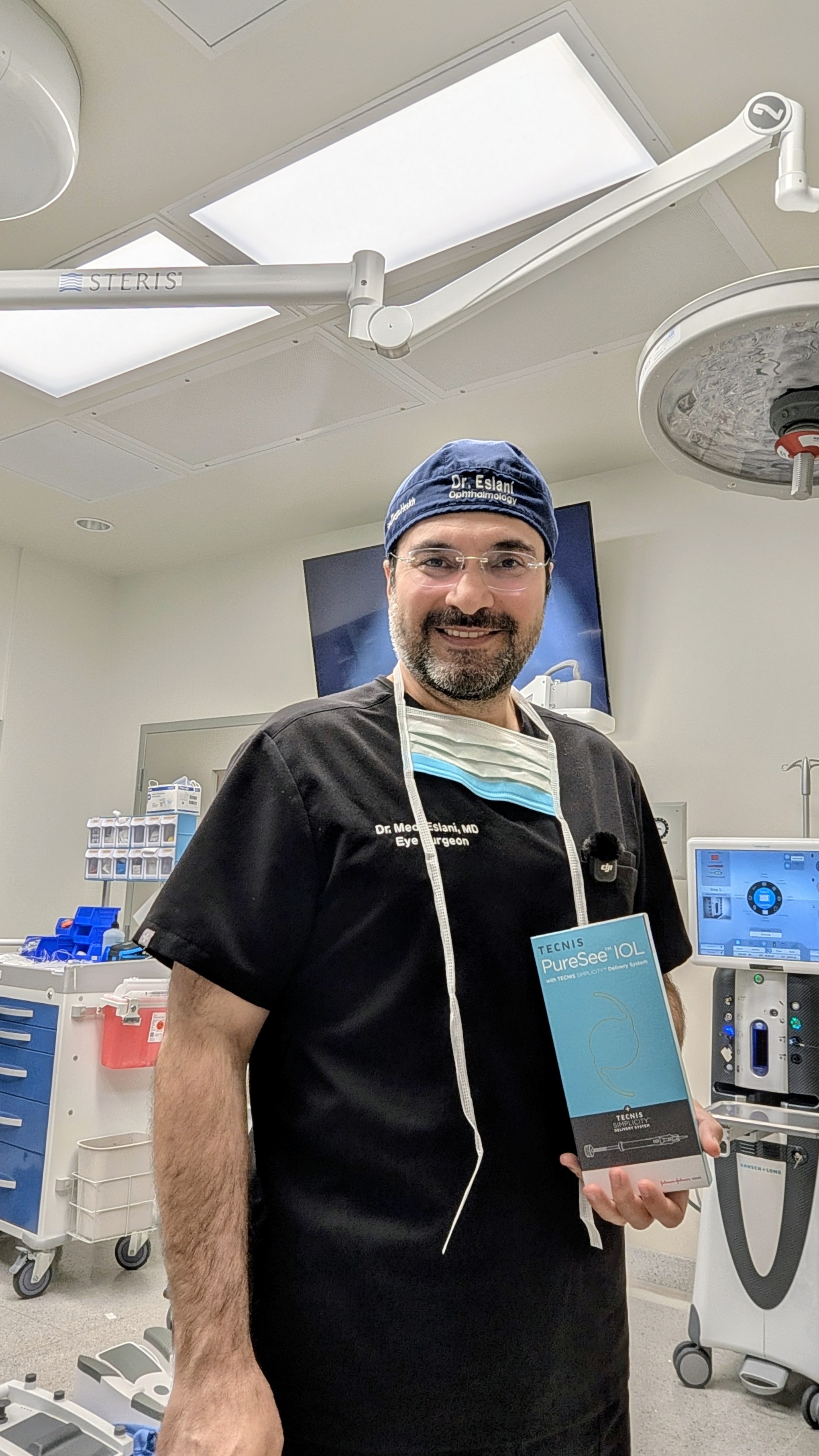
Dr. Eslani with the TECNIS PureSee lens in the operating room.
Full range of vision
Distance, intermediate, and near
enVista Envy (Bausch + Lomb), TECNIS Odyssey (Johnson & Johnson), and Clareon PanOptix Pro (Alcon). These lenses divide light across focal points to give the greatest overall independence from glasses.
Extended depth of focus
A smooth, continuous range
TECNIS PureSee (Johnson & Johnson) and Clareon Vivity (Alcon). Rather than splitting light into separate zones, these stretch one focal point into a range, giving strong distance and intermediate vision with fewer night-time visual symptoms.
Enhanced monofocal
Distance, with more intermediate
TECNIS Eyhance (Johnson & Johnson), enVista Aspire (Bausch + Lomb), and RayOne EMV (Rayner). A refined monofocal optic that adds useful intermediate vision while keeping the night-vision profile of a standard monofocal.
Refractive multifocal
Distance and near, no diffractive rings
ClearView 3 (Lenstec), a rotationally asymmetric refractive multifocal that provides distance and near vision through separate optical zones rather than concentric diffractive rings.
Monofocal
One sharp zone, covered by insurance
enVista (Bausch + Lomb), TECNIS Monofocal ZCB00 (Johnson & Johnson), Clareon (Alcon), and ZEISS CT LUCIA. One sharp focal distance, usually set for distance, with reading glasses for near. This is the lens category covered by Medicare and most insurance.
Astigmatism
Toric options across the range
Astigmatism does not rule out any of the above. Toric versions are available across these lens platforms, correcting astigmatism at the same time as the cataract so your distance vision is sharp without glasses.
Intraoperative verification
The ORA System, used on every premium lens
Lens power is normally calculated from measurements taken before surgery, while the cataract is still sitting in the eye. The ORA System measures your eye's actual focusing power during the procedure, once the cataract has been removed and again after the new lens is in place. Dr. Eslani uses it routinely on every premium lens.
This matters because premium lenses have little tolerance for leftover prescription: a small refractive miss that a monofocal patient would barely notice can measurably reduce how well a full-range lens performs. Intraoperative measurement is most valuable in eyes that have had previous LASIK, PRK, or RK, where the standard preoperative formulas are least reliable, and for confirming the alignment of astigmatism-correcting lenses.
Every lens that extends your range of vision involves some trade-off. Because full-range lenses divide light between focal points, halos and glare around lights at night are possible, and are usually most noticeable in the first months while your brain adapts. In the enVista Envy FDA clinical trial, for example, 80% of patients described halos as not at all or only a little bothersome. Dr. Eslani will talk through these trade-offs honestly and match the lens to how you actually use your eyes, rather than defaulting to one lens for every patient.
Recovery
What healing actually looks like
Most patients are surprised by how undramatic recovery is. You will use prescription drops for a few weeks and wear a light shield at night at first. This is the typical course, though Dr. Eslani tailors it to your eyes and any other conditions you have.
First 24 hours
Rest and haze
You go home the same day. Vision is often hazy or filmy at first and light can seem unusually bright. A mild gritty feeling is normal and settles quickly.
Days 1 to 7
The change becomes obvious
Most patients notice a clear improvement within the first few days, and you are seen for a follow-up visit in this window. Many people are cleared to drive once vision meets the legal standard. Avoid rubbing the eye, swimming, and heavy lifting.
Weeks 2 to 4
Settling and sharpening
Vision continues to sharpen and stabilize as the eye quiets down. Most normal activity and exercise resume, and your drop schedule begins to taper.
Weeks 4 to 8
Your final result
The eye has settled. If you need a glasses update for any residual prescription, this is usually when it is measured. If your second eye needs surgery, it is typically scheduled a short interval after the first.
Healing is not identical for everyone. Dry eye, glaucoma, diabetes, and previous eye surgery all influence the course. Because Dr. Eslani is fellowship-trained in glaucoma and built his research career in cornea and ocular surface disease, those factors are identified and planned for before your surgery rather than managed as a surprise afterward.
Safety & Results
One of the most successful operations in medicine
Cataract surgery is among the most frequently performed and most carefully studied operations in the world, with millions carried out in the United States every year. The great majority of patients come through with clearer vision and no complication at all.
It is still surgery, and no operation is entirely without risk. Infection, swelling, pressure changes, and retinal problems are all possible, and occasionally a further procedure is needed. Your individual risk depends on your eyes, your prescription, and your general health. Dr. Eslani will walk you through your specific risks and a realistic expectation of your result, in plain language, before you commit to anything.
A common question
Can a cataract come back?
No. Once the clouded natural lens has been removed it cannot regrow, so the cataract itself is gone permanently.
What can happen later
Clouding behind the implant
Months or years later, the thin membrane that holds the lens implant can turn hazy. It is corrected with a YAG laser capsulotomy: a painless treatment that takes a few minutes in the office and does not mean returning to the operating room.
Why Dr. Eslani
A surgeon-scientist, not a surgery mill
Choosing a cataract surgeon is about more than the fifteen minutes in the operating room. It is about who measures your eye, who selects the lens, and who is there if something needs attention afterward.
Training
Fellowship-trained at UC San Diego
Ophthalmology residency and glaucoma fellowship at the Shiley Eye Institute, UC San Diego, training under Dr. Robert N. Weinreb, one of the world's foremost authorities on glaucoma.
Research
Heed Fellow with 70+ publications
An internationally recognized research career in cornea and ocular surface disease, recognized with the Heed Fellowship, more than 70 peer-reviewed publications and textbook chapters, and Best Poster awards at ASCRS and the American Academy of Ophthalmology.
Scope
Cataract, glaucoma, and cornea in one surgeon
Many people who need cataract surgery also have glaucoma or a compromised ocular surface. Dr. Eslani treats all three, so your plan accounts for the whole eye rather than one problem at a time.
Access
Unhurried care, in your language
Thorough consultations with room for your questions, supported by a Spanish- and Tagalog-speaking team across offices in Chula Vista, National City, Escondido, and El Centro.
Interviewing more than one practice before you decide? Good — you should. Our plain-English guide shows you exactly what to compare, question by question.
FAQ
Cataract surgery questions
Is cataract surgery covered by insurance?
How long does cataract surgery take?
Is cataract surgery painful?
Will I still need glasses afterward?
When can I drive again?
Explore
Related treatments
Dr. Eslani provides the full range of surgical and medical eye care across San Diego County and the Imperial Valley.
Glaucoma & MIGS
Lower eye pressure with SLT, MIGS, and sustained-release therapy.
Learn more →
LASIK & PRK
Laser vision correction tailored to your cornea and lifestyle.
Learn more →
Refractive Lens Exchange
Lasting freedom from reading glasses, with no cataract later.
Learn more →
Dry Eye & Ocular Surface
Treat the root cause of dry eye, not just the symptoms.
Learn more →
Ready to see clearly again?
Schedule your cataract consultation with Dr. Eslani today.